GPT‑6 Cyber: OpenAI’s specialist model for cybersecurity research
The November 5 system card covers ExploitGym results, task boundaries and restricted Daybreak Red access. What the announcement means for teams building AI projects.
Securing an AI service still involves ordinary software work: investigating failures, reviewing libraries and validating fixes. GPT‑6 Cyber is OpenAI's specialist model for that research. Its system card was published on November 5. The central development combines stronger vulnerability research with training to respect the limits of an authorized task.
What the model is
The system card describes GPT‑6 Cyber as a GPT‑6 Astra variant with additional training for authorized cybersecurity work. Its scenarios include vulnerability discovery, reproducibility checks and web-application research. It is a specialist tool rather than a new image, video or voice generation model.
OpenAI's announcement describes initial API and Codex access for a select group of approved Daybreak Red customers, followed by expansion. An ordinary subscription alone does not establish that a particular user can already access the model. Availability and an organization's permission to use it are separate questions.
How to interpret the results
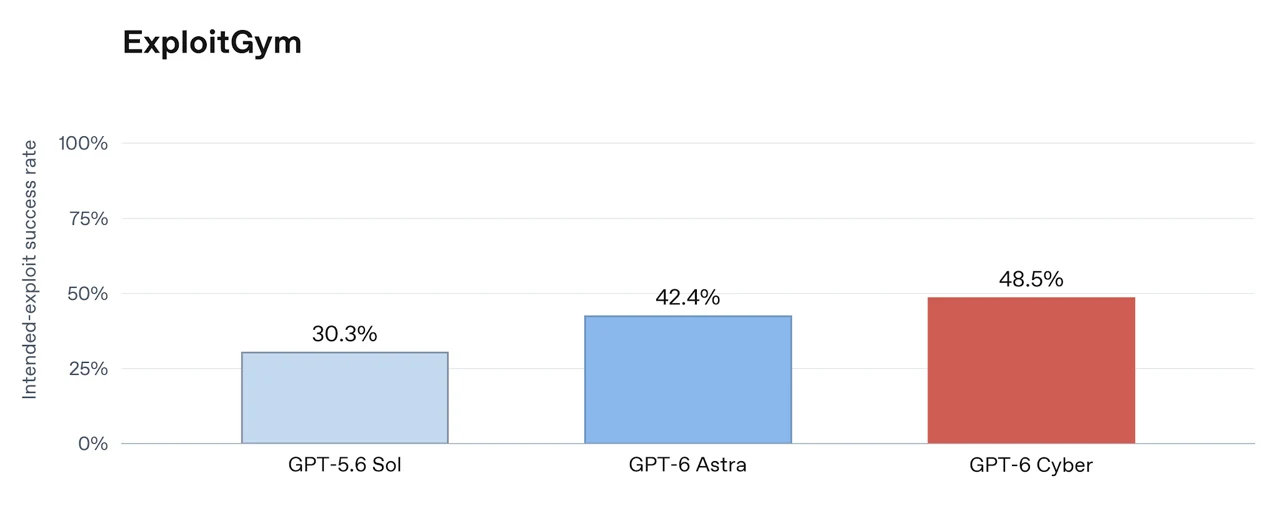
OpenAI's original ExploitGym chart reports 48.5% for GPT‑6 Cyber, 42.4% for GPT‑6 Astra and 30.3% for GPT‑5.6 Sol. This benchmark tests exploitation of a specified vulnerability in a remote software target. It does not measure the proportion of every unknown defect the model will discover in an arbitrary website.
The comparison is useful as a result from a defined evaluation. It cannot become a promise to assess any service successfully, or proof that a project is secure after one run. The illustration here is OpenAI's original chart, not a VIZURAI measurement.
Task boundaries matter alongside capability
The system card describes training to respect restrictions and report work accurately. Results still vary across individual evaluations: weaknesses remain, including in reporting blockers. A strong result on one benchmark therefore does not remove the need to check actions and conclusions.
Daybreak documentation also explains that selecting an access program in a request does not grant permission. Organization and project approval, model permissions and the supported way of using the service are separate requirements. That distinction matters to teams planning adoption, rather than merely following the announcement.
What this means for an AI-project owner
Consider an editorial example: a team is preparing to review its own file-upload library. Before the research begins, it should define a test copy, the components being assessed and the expected deliverable: a reproducible report and a proposed fix. A person then needs to establish that the fix addresses the defect while preserving normal application behavior.
Keep a hypothesis, a confirmed issue and a repaired defect distinct in the report. This makes the research useful to a developer and helps avoid confusing a convincing account with a verified change. The example describes how to organize a review, not an audit performed on our website.
Availability and the takeaway
For media creators, this concerns the infrastructure behind services and tools rather than a reason to switch creative models. This article does not announce GPT‑6 Cyber integration in VIZURAI, a site audit using it, or repairs to particular defects. An interested team should next examine Daybreak requirements and identify an appropriate task in its own authorized test environment.
Create your own result
Choose an available model and check its price in the studio.